Paramhans Industry
June 01, 2026
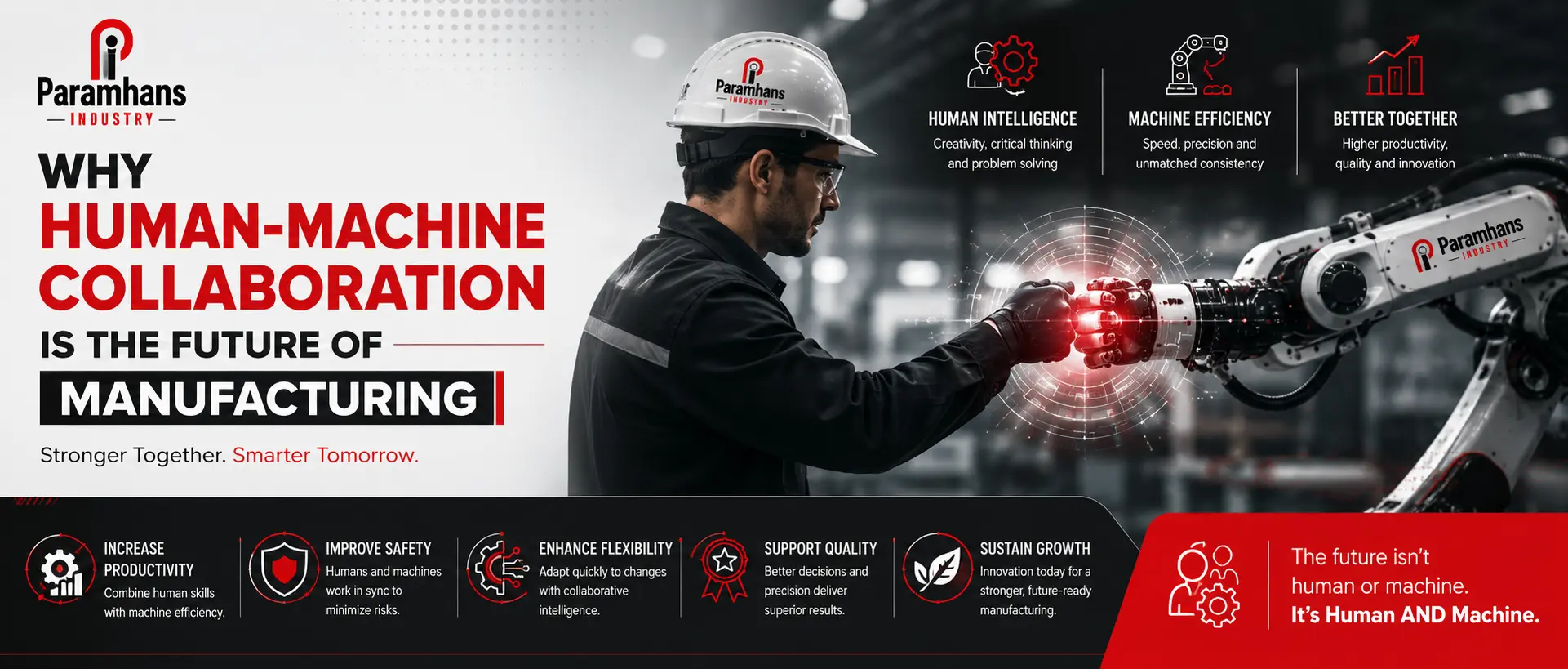
The Manufacturing Shift That Traditional Systems Can No Longer Ignore
Manufacturing environments are changing faster than many industrial systems were originally designed to handle. Production demands are becoming more dynamic, product customization is increasing, and operational efficiency expectations continue to rise across industries.
At the same time, manufacturers are dealing with skilled labor shortages, stricter safety requirements, and growing pressure to improve consistency without slowing output. These challenges have accelerated interest in human-machine collaboration — a manufacturing approach where people and intelligent machines work together rather than operating in isolation.
Instead of replacing human involvement entirely, collaborative manufacturing focuses on combining human judgment, adaptability, and problem-solving abilities with the speed, precision, and repeatability of industrial automation systems.
As industries adopt smarter production ecosystems, businesses are also exploring integrated industrial infrastructure through nationwide manufacturing and automation networks such as Paramhans Industries’ operational presence across regions to support scalable industrial transformation.
What Is Human-Machine Collaboration?
Human-machine collaboration refers to a manufacturing model where workers and automated systems interact in coordinated workflows to improve productivity, accuracy, safety, and operational efficiency. Instead of functioning independently, humans and machines share tasks based on their strengths within the production environment.
In modern manufacturing, this collaboration often includes robotics, industrial sensors, AI-driven systems, machine vision, programmable logic controllers (PLCs), and connected monitoring technologies that support real-time decision-making on the shop floor.
Human-Machine Collaboration in Manufacturing: A Simple Explanation
Human-machine collaboration in manufacturing combines human expertise with machine automation to perform industrial tasks more efficiently. Humans contribute flexibility, reasoning, and oversight, while machines handle repetitive, high-speed, or precision-based operations. Together, they create safer, more adaptive, and data-driven manufacturing processes.
Why Human-Machine Collaboration Matters in Modern Manufacturing
The growing adoption of Industry 4.0 technologies has made connected manufacturing environments more practical and accessible than ever before. However, digital transformation alone does not automatically improve production performance.
Human-machine collaboration matters because it creates balance between automation and operational intelligence.
Key Reasons Manufacturers Are Prioritizing Collaborative Systems
1. Improved Operational Efficiency
Machines excel at repetitive processes such as:
- Material handling
- Precision assembly
- Quality inspection
- Automated packaging
- Predictive monitoring
Meanwhile, human operators manage:
- Decision-making
- Process adjustments
- Exception handling
- Quality interpretation
- Troubleshooting
This division of responsibilities helps reduce production bottlenecks.
2. Better Workplace Safety
Collaborative robotic systems and sensor-based industrial tools can reduce exposure to hazardous environments, repetitive strain tasks, and high-risk machinery operations.
In many facilities, human-machine collaboration is helping minimize manual intervention in areas involving:
- Heat-intensive operations
- Chemical handling
- Heavy lifting
- High-speed machinery
- Repetitive motion activities
3. Greater Manufacturing Flexibility
Traditional automation systems were often rigid and difficult to reconfigure. Collaborative systems are more adaptable, making them suitable for:
- Variable product batches
- Customized production
- Multi-stage assembly
- Shorter production cycles
This flexibility is becoming increasingly valuable in sectors such as automotive, electronics, pharmaceuticals, and industrial equipment manufacturing.
4. Data-Driven Decision Support
Connected machines generate continuous operational data. Human operators can interpret this information to improve:
- Preventive maintenance planning
- Process optimization
- Energy management
- Downtime reduction
- Quality consistency
Rather than replacing human expertise, intelligent systems enhance it.
Human vs Fully Automated Manufacturing: Understanding the Difference
One common misconception is that human-machine collaboration means fully autonomous factories with minimal workforce involvement. In practice, collaborative manufacturing differs significantly from complete automation.
Human-Centered Collaboration
In collaborative systems:
- Humans remain actively involved
- Machines assist operational tasks
- Decision-making remains supervised
- Flexibility is prioritized
- Processes adapt more easily
Fully Autonomous Manufacturing
In highly autonomous systems:
- Human involvement is limited
- Systems operate independently
- Production follows fixed programming
- Reconfiguration can be complex
- Oversight depends heavily on software infrastructure
For many manufacturers, collaborative models offer a more balanced and scalable transition toward smart manufacturing without requiring complete operational restructuring.
How Human-Machine Collaboration Works in Manufacturing
The implementation process varies depending on industry requirements, production scale, and operational complexity. However, most collaborative manufacturing environments follow several common stages.
1. Process Evaluation
Manufacturers first identify tasks suitable for automation and tasks requiring human judgment.
Examples include:
- Repetitive assembly
- Visual inspection
- Inventory movement
- Welding assistance
- Sensor monitoring
2. Technology Integration
Industrial technologies are introduced into workflows, including:
- Collaborative robots (cobots)
- Industrial IoT systems
- Machine vision platforms
- AI-enabled monitoring systems
- Smart industrial tools
These technologies are designed to interact safely with operators.
3. Workflow Coordination
Production systems are structured so humans and machines operate in synchronized processes rather than isolated stations.
For example:
- Machines may prepare components
- Operators perform precision adjustments
- AI systems monitor quality metrics
- Sensors trigger operational alerts
4. Real-Time Monitoring
Connected systems continuously analyze performance data to support:
- Predictive maintenance
- Production analytics
- Error detection
- Resource optimization
5. Continuous Improvement
Collaborative environments evolve over time through:
- Operator feedback
- Data analysis
- Process refinement
- System upgrades
- Training improvements
Technologies Commonly Used in Human-Machine Collaboration
Several industrial technologies support collaborative manufacturing ecosystems today.
Core Technologies Include:
- Collaborative robots (Cobots)
- Industrial automation systems
- Artificial intelligence platforms
- Machine learning tools
- Human-machine interfaces (HMIs)
- Industrial Internet of Things (IIoT)
- Smart sensors
- Machine vision systems
- PLC and SCADA systems
- Predictive maintenance software
Industrial suppliers and automation solution providers such as Paramhans Industries often support manufacturers in integrating compatible industrial tools and automation components into evolving production systems.
Requirements Before Implementing Human-Machine Collaboration
Before adopting collaborative manufacturing systems, organizations typically evaluate several operational and technical requirements.
Important Considerations Include:
- Existing production infrastructure assessment
- Machine compatibility analysis
- Workforce training readiness
- Safety compliance requirements
- Data connectivity capabilities
- Industrial network reliability
- Cybersecurity planning
- Maintenance support systems
- Scalability potential
- Integration with legacy equipment
Successful implementation often depends more on workflow planning than on technology alone.
Common Challenges in Human-Machine Collaboration
While collaborative manufacturing offers significant advantages, implementation is not always straightforward.
1. Integration Complexity
Older manufacturing systems may not easily connect with modern automation platforms.
This can create:
- Communication gaps
- Data inconsistency
- Software compatibility issues
2. Workforce Adaptation
Employees may initially resist operational changes due to concerns about:
- Job displacement
- Technology unfamiliarity
- Skill transition requirements
Clear training and communication strategies are essential.
3. Cybersecurity Risks
Connected manufacturing systems increase exposure to:
- Data breaches
- Unauthorized access
- Industrial network vulnerabilities
Industrial cybersecurity planning is becoming increasingly important.
4. Maintenance and Downtime
Collaborative systems require:
- Routine calibration
- Software updates
- Sensor maintenance
- Monitoring infrastructure
Without proper maintenance planning, efficiency gains may decline.
Key Considerations Before Moving Toward Collaborative Manufacturing
Manufacturers considering human-machine collaboration should evaluate long-term operational objectives rather than focusing only on short-term automation benefits.
Important Questions to Consider
1. Is the workflow repetitive or variable?
Highly repetitive processes may benefit more from automation assistance.
2. Can operators safely interact with equipment?
Safety standards and workspace design are critical.
3. Is the existing infrastructure digitally compatible?
Legacy systems sometimes require phased modernization.
4. Does the workforce require technical upskilling?
Operator training significantly affects adoption success.
5. Will the system scale with future production needs?
Scalability planning helps avoid fragmented automation investments.
Frequently Asked Questions
1. Is human-machine collaboration replacing factory workers?
No. In most manufacturing environments, collaborative systems are designed to support workers rather than eliminate them. Machines handle repetitive or hazardous tasks, while humans continue managing supervision, adaptability, quality interpretation, and operational decision-making.
2. What industries use human-machine collaboration the most?
Industries commonly using collaborative manufacturing include:
- Automotive
- Electronics
- Pharmaceuticals
- Food processing
- Aerospace
- Heavy engineering
- Packaging
- Industrial equipment manufacturing
3. Are collaborative robots safe to work with?
Collaborative robots are specifically designed with safety features such as motion sensors, force limitations, and emergency stop mechanisms. However, proper installation, risk assessment, and operator training remain essential.
4. What is the difference between automation and collaboration?
Automation focuses on reducing manual intervention, while collaboration focuses on combining human skills with machine efficiency. Collaborative systems maintain active human involvement within automated workflows.
5. Does human-machine collaboration require complete factory modernization?
Not always. Many manufacturers implement collaborative technologies gradually by upgrading selected workflows, production cells, or operational stages rather than rebuilding entire facilities.
When Professional Industrial Guidance Makes Sense
Human-machine collaboration involves more than installing robots or connecting machines to software platforms. Effective implementation often requires coordination between operational planning, industrial safety, automation compatibility, workforce training, and infrastructure scalability.
Professional industrial guidance may become valuable when manufacturers are:
- Expanding production capacity
- Modernizing legacy systems
- Improving operational efficiency
- Introducing smart manufacturing practices
- Reducing process variability
- Enhancing workplace safety
- Planning Industry 4.0 adoption
An experienced industrial solutions provider can help evaluate practical integration pathways without disrupting core production continuity.
Conclusion
Human-machine collaboration is reshaping how modern manufacturing systems operate. Rather than replacing human capability, collaborative manufacturing strengthens it through intelligent automation, connected industrial tools, and data-supported decision-making.
As production environments become more dynamic and efficiency expectations continue to increase, manufacturers are moving toward systems where people and machines operate together in coordinated workflows.
The future of manufacturing is unlikely to be fully human-driven or entirely machine-controlled. Instead, it will increasingly depend on balanced collaboration between skilled operators and intelligent industrial technologies.
Businesses evaluating collaborative manufacturing strategies should consider operational compatibility, workforce readiness, long-term scalability, and system integration requirements carefully before implementation. Consulting experienced industrial automation professionals can help organizations make more informed decisions based on their production goals and infrastructure needs.
Connect with our consultants for complete guidance on Paramhans Industry. Visit our Contact Us page for assistance and to learn more about Paramhans Industry Visit About Us page.
Social Share:





Our Blog



Captcha