Paramhans Industry
September 23, 2026
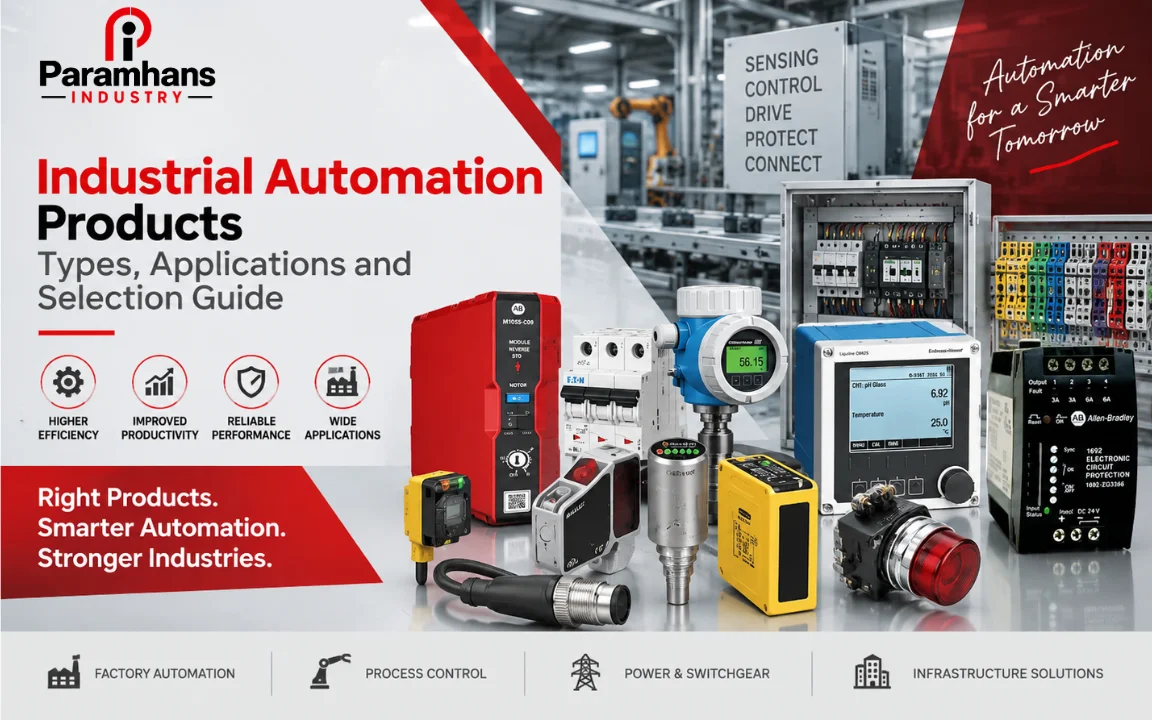
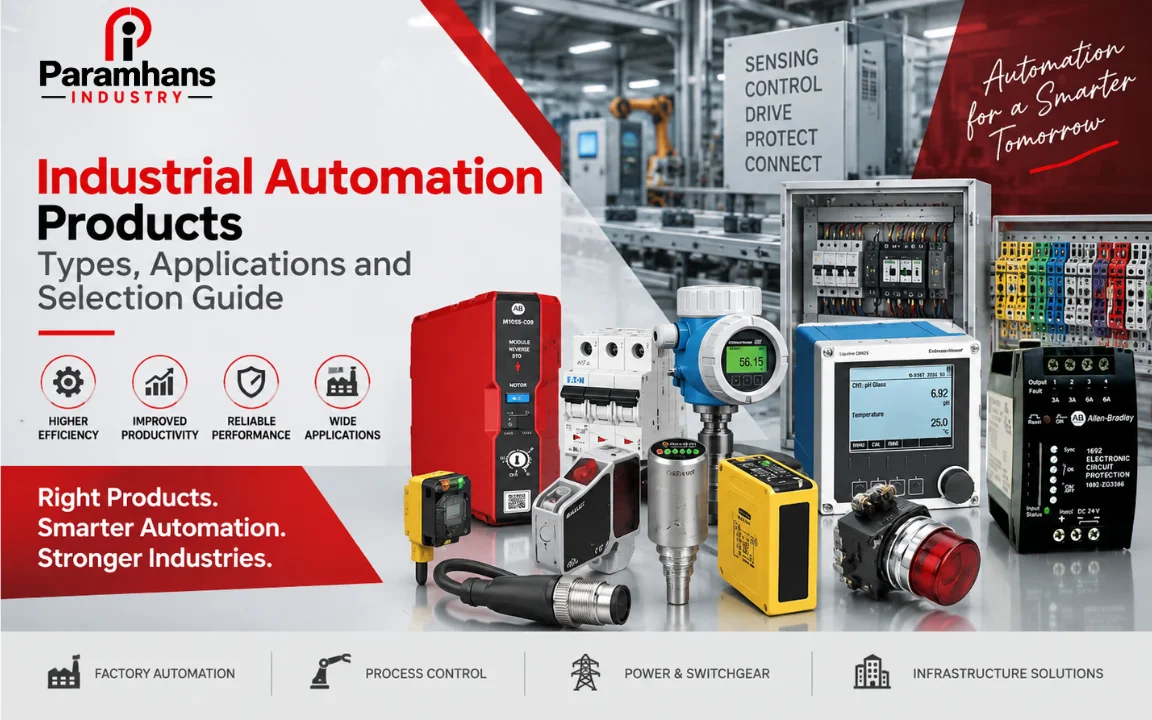
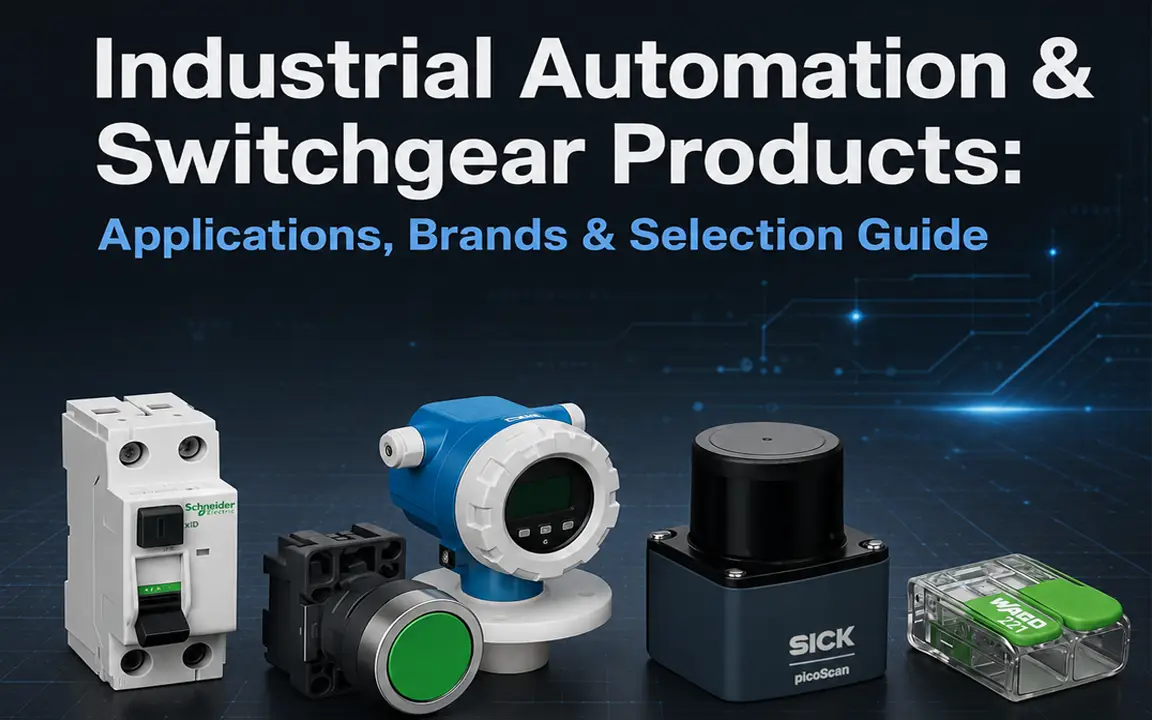
Industrial automation products are the hardware and control devices that help machines monitor conditions, make decisions and perform repeatable tasks. A typical system may use sensors to detect a part, a PLC to process the signal, an HMI to let an operator view or change settings, and a VFD to control a motor. The right combination depends on the process, environment, safety requirements and plans for future expansion.
For a buyer, the challenge is rarely finding a device with the right name. It is confirming that the specifications, communication interfaces, electrical ratings and accessories work together. This guide explains the main product types, where they are used and what to check before requesting a quotation. Paramhans Industry lists industrial automation and switchgear products among its supply categories and offers products from established industrial brands; availability and model suitability should be confirmed for each requirement.
What are industrial automation products?
Industrial automation products are components used to sense, control, operate, protect or connect equipment in an industrial process. They range from individual sensors and relays to programmable controllers, motor drives, operator panels and communication hardware. Some products perform a single task, while others form part of a coordinated control system.
Automation does not always mean a fully unmanned factory. It can mean a pump that starts when tank level falls, a conveyor that stops when a guard opens, or a packaging line that keeps speed consistent. The devices selected should make the operation more predictable while giving operators and maintenance teams enough visibility to identify problems.
How an automation system works
A simple automation loop follows four steps: detect, decide, act and report. A sensor detects a physical condition such as position, pressure, temperature or flow. A controller evaluates that input against programmed logic. An output device, such as a contactor, valve or drive, changes the process. An HMI or supervisory system can then show status, alarms and production information to people.
Not every installation needs every layer. A small machine may use a compact PLC, a few sensors and push buttons. A larger plant could connect several controllers, distributed input/output, industrial networks, safety devices and a supervisory control system. Start with the process and required outcomes; then specify the products that support them.
Main types of industrial automation products
1. Programmable logic controllers
A programmable logic controller (PLC) is an industrial computer designed to read input signals, run control logic and update outputs. It can coordinate machine sequences, interlocks, alarms, timing and communication with other devices. PLCs are widely used because their logic can be changed and maintained without redesigning a complete hard-wired control circuit.
A PLC is suitable when a process needs repeatable logic, multiple inputs and outputs, or room to modify the sequence later. Compact PLCs suit smaller machines; modular PLCs allow the user to add I/O, communication or specialty modules as a system grows. Before choosing one, count digital and analogue points, identify required response times, confirm supply voltage and check the programming environment and support available to the maintenance team.
2. Human-machine interfaces
A human-machine interface (HMI) gives operators a visual way to monitor and interact with a machine. It may display operating status, process values, alarm messages, trends and recipes. Depending on the design, an HMI can let an authorised operator adjust setpoints or select operating modes without changing the PLC program.
Choose an HMI based on screen size, resolution, mounting style, viewing distance, environmental rating and language needs. Check that it communicates with the controller using a supported protocol and that the required tags, alarms and screens fit its memory and performance limits. A clear interface should make important conditions easy to recognise, not bury them among decorative graphics.
3. Variable frequency drives
A variable frequency drive (VFD), also called an AC drive, controls the speed and torque of a compatible AC motor by varying the frequency and voltage supplied to it. Drives can support process control and smoother starts, and they may reduce energy use in applications where motor speed can be lowered to match demand. Actual savings depend on the load, operating profile, system design and commissioning.
When selecting a VFD, match it to the motor nameplate and application. Confirm input voltage and phase, motor power and current, overload duty, speed range, control method, braking needs, enclosure, ambient temperature and installation conditions. Pumps and fans may have different load characteristics from conveyors, mixers or hoists. Also check cable length, harmonic considerations, EMC requirements and whether the drive needs external braking or line-side accessories.
4. Industrial sensors
Industrial sensors convert a physical condition into a signal that a controller can use. Common examples include proximity, photoelectric, pressure, temperature, level, flow and position sensors. Their selection starts with the target: material, size, distance, movement, temperature, contamination and the accuracy needed.
Inductive proximity sensors detect metal objects without physical contact. Capacitive sensors can detect some non-metallic materials as well as metals, subject to the application. Photoelectric sensors use light to detect objects across a gap, making them useful for counting or presence checks. Temperature, pressure and flow instruments measure process variables. Confirm sensing range, output type, supply voltage, switching frequency, mounting, connector and ingress protection before ordering.
5. Industrial switches, relays and contactors
Switches and relays help control or isolate circuits; contactors are electrically operated switches commonly used for switching power loads such as motors. Auxiliary contacts can report a device state to a control system. These products may appear simple, but selecting them involves current and voltage ratings, utilization category, coil voltage, number of poles, short-circuit coordination and the intended switching frequency.
A control relay should not be treated as a substitute for a correctly rated motor contactor. Likewise, routine control devices are not automatically safety-rated. Use equipment that matches the electrical design and applicable safety requirements, and have protection and coordination checked by a qualified electrical professional.
6. Power supplies, circuit protection and terminal blocks
Control panels need stable power for PLCs, sensors, HMIs and communication equipment. Industrial power supplies convert incoming AC or DC to the voltage required by control devices. Circuit breakers, fuses and overload relays protect circuits and equipment when chosen and coordinated correctly. Terminal blocks provide organised connection points for field wiring, panel wiring and test circuits.
Check output voltage and current, derating, redundancy needs, short-circuit protection, operating temperature and mounting. For protection devices, confirm breaking capacity and coordination with upstream and downstream equipment. For terminal blocks, verify conductor size, current rating, mounting system, accessories and marking method. Reliable panel layouts make fault-finding and future maintenance easier.
7. Industrial communication and networking products
Industrial communication hardware connects controllers, drives, HMIs, remote I/O and higher-level systems. Depending on the plant, this may include Ethernet switches, gateways, serial converters, communication modules, connectors and cables. Protocol compatibility matters: two devices with Ethernet ports may still not exchange useful data unless they support a common protocol and configuration.
Plan the network around device count, topology, distance, noise exposure, redundancy and cybersecurity requirements. Confirm whether a switch is designed for the electrical and environmental conditions of the installation. Document addressing, firmware, configuration backups and network ownership so that future changes do not depend on undocumented settings.
8. Safety automation devices
Safety-related products may include emergency-stop devices, safety relays, interlock switches, light curtains, safety controllers and safe drive functions. Their purpose is to reduce risk when people interact with machinery. The correct solution depends on a machine risk assessment, required performance level or safety integrity target, architecture and validation plan.
Do not select safety equipment from a catalogue description alone. A qualified machine-safety professional should confirm the design, wiring, diagnostics, reset behaviour and validation against applicable standards and local rules. Ordinary PLC logic or a standard sensor should not be assumed to provide a safety function unless the complete design is specifically rated and validated for that purpose.
Applications across industries
Industrial automation products are used wherever equipment must operate in a controlled, repeatable way. In manufacturing, PLCs coordinate assembly, packaging, inspection and material handling. Sensors detect product presence or machine position, while HMIs show operating state and fault messages. VFDs can regulate conveyors, pumps, fans and other compatible motor-driven equipment.
In food and beverage plants, level, temperature and flow instruments support process monitoring, while washdown conditions make enclosure and material selection especially important. In water and wastewater facilities, controllers and instruments can manage pumping, tank levels and alarms. Warehouses use sensors and drives in conveyors and sortation systems. Utilities, building services and process industries use automation for monitoring and equipment control, with product choice shaped by the process and operating environment.
For every application, define what must be measured, controlled, reported and protected. A product used successfully in one line may be unsuitable in another because of dust, moisture, vibration, hazardous-area classification, washdown chemicals or ambient heat.
How to select industrial automation products
1. Describe the process and the required result
Write down what the machine or process must do, what starts and stops it, which conditions require an alarm, and what operators need to see. Include normal operation, cleaning, changeover, fault recovery and maintenance. Clear requirements prevent a component list from becoming a collection of disconnected catalogue choices.
2. Build an I/O and device list
List every signal: digital inputs such as limit switches, digital outputs such as solenoid commands, analogue inputs such as pressure transmitters, and analogue outputs such as speed references. Note the signal type, range, location and whether it is safety-related. Add likely spare capacity based on the expansion plan rather than an arbitrary percentage.
3. Check electrical and environmental compatibility
Confirm voltage, phase, current, frequency, motor data and available short-circuit capacity. Consider panel temperature, humidity, dust, water, vibration, corrosive substances and altitude where relevant. The enclosure rating and cooling approach should match the real site conditions. A device’s stated rating is only meaningful when installation and derating requirements are followed.
4. Verify communication and integration
Match protocols, connector types, data formats and software tools across PLCs, HMIs, drives and sensors. Establish who will configure the system and whether the required engineering software, cables, licenses and technical support are available. If equipment will connect to plant networks, involve the responsible IT/OT stakeholders early.
5. Consider safety, compliance and documentation
Identify legal, customer and plant requirements before ordering. Confirm applicable product approvals, certificates and documentation for the intended market and use. Safety devices require a risk-based design and validation; they cannot be substituted by choosing a product with a safety-related label alone. Keep datasheets, wiring diagrams, parameter files and manuals with the machine records.
6. Compare lifecycle cost and support
Purchase price is only one part of cost. Consider lead time, installation effort, energy use, spares, downtime risk, training, software availability and replacement compatibility. Standardising selected product families can simplify maintenance, but avoid forcing a standard where it creates a technical mismatch. Ask suppliers about genuine products, traceability, warranty conditions and after-sales support.
7. Confirm the complete bill of materials
A selected device may need matching cables, connectors, mounting brackets, communication modules, protection, fuses, braking resistors, power supplies or programming tools. Ask for a reviewed bill of materials and cross-check model numbers, quantities, accessories and delivery requirements before purchase. This reduces delays caused by an otherwise compatible device arriving without the part needed to install it.
Common selection mistakes to avoid
- Choosing by product name or lowest price without checking ratings, duty and site conditions.
- Selecting a PLC before estimating I/O, communication needs and future changes.
- Assuming that every sensor detects every material or works reliably at its maximum stated range.
- Sizing a VFD only by motor kilowatts and ignoring current, overload, load type or installation conditions.
- Overlooking connectors, cables, mounting hardware, programming access or commissioning responsibilities.
- Treating standard control components as safety-rated devices without a validated safety design.
- Failing to keep backups of PLC programs, HMI projects, drive parameters and network settings.
Sourcing automation components for a project
A useful enquiry gives the supplier enough information to identify the correct product or flag missing details. Share the application, manufacturer preference if any, exact model or approved equivalent rules, voltage and current, required quantity, delivery location and required date. Attach a datasheet, panel schedule, I/O list, motor nameplate or existing part photograph where available. For replacement purchases, confirm the full model code and revision because similar product names can have different ratings or interfaces.
Buyers should also clarify whether the requirement is for supply only or includes engineering, programming, installation or commissioning. These are different scopes. Paramhans Industry’s website identifies it as a supplier across industrial automation and switchgear, among other categories, and describes support for genuine products from established brands. Ask the company to confirm current availability, exact specifications, documentation and delivery terms for the required models before placing an order.
Frequently asked questions
1. What are industrial automation products?
They are devices used to monitor and control industrial equipment. Examples include PLCs, HMIs, VFDs, sensors, relays, contactors, power supplies, safety devices and communication hardware.
2. What is the difference between a PLC and an HMI?
A PLC reads inputs and executes control logic. An HMI presents information to operators and can allow authorised interaction with the process. They often communicate as parts of the same control system.
3. What does a VFD do in an industrial system?
A VFD controls the speed and torque of a compatible AC motor by changing its supply frequency and voltage. It is commonly used where motor speed needs to match process demand.
4. How do I choose the right industrial sensor?
Start with the target material, sensing distance, object size and speed, ambient conditions, output type, mounting method and controller input. Verify performance for the actual application and installation.
5. Can different brands of PLC, HMI and VFD work together?
Often they can if they share a supported communication protocol and compatible data configuration. Confirm specific models, firmware, protocol options and engineering tools before purchase.
6. What information is needed to select a PLC?
Provide the I/O list, signal types, required communication protocols, supply voltage, control task, response needs, expansion plans and the programming environment used by the maintenance team.
7. How is a VFD sized for a motor?
Check motor nameplate voltage and current, power, load type, overload duty, speed range and operating environment. An engineer should also consider cable length, braking, harmonics and protection requirements.
8. Are proximity and photoelectric sensors interchangeable?
No. Inductive proximity sensors are commonly used to detect metal at short range. Photoelectric sensors use light and can detect a wider range of objects, but performance depends on target, background and environment.
9. What is the difference between standard and safety automation?
Standard automation controls normal machine operation. Safety automation uses components and architectures selected through risk assessment and validated to achieve a defined risk-reduction target.
10. Which automation products are suitable for a dusty or wet area?
Choose products with enclosures, connectors and installation methods rated for the site exposure. Consider cleaning methods, temperature and chemical contact, and verify the full assembly rather than only one device rating.
11. Do automation components need to come from the same manufacturer?
Not necessarily. Multi-brand systems are common, but compatibility, software support, protocol configuration, warranties and spare-parts management must be checked.
12. What should I include when requesting a quotation?
Include exact model numbers or performance requirements, quantities, application, electrical ratings, accessories, delivery location, required date and any documentation or certification needs.
13. Why are compatible accessories important?
Cables, connectors, mounting parts, communication modules and protection devices can be essential for installation and operation. Missing accessories can delay commissioning even when the main product is correct.
14. Can a supplier recommend a substitute automation product?
A supplier may identify an alternative, but the buyer or responsible engineer should approve it after checking ratings, interfaces, approvals, dimensions, software and application suitability.
15. How can I reduce downtime when replacing an automation component?
Record the complete model and configuration, keep backups and wiring details, verify the replacement’s compatibility, and confirm the required accessories and lead time before the planned changeover.
Conclusion
Choosing industrial automation products is a system decision. PLCs, HMIs, VFDs, sensors and supporting components must match the process, electrical design, environment and maintenance capability. Start with clear requirements, verify interfaces and ratings, account for safety and accessories, and compare lifecycle support as well as purchase cost. With a complete specification and a reviewed bill of materials, buyers can source components more confidently and reduce avoidable delays during installation and operation.
For automation and switchgear product enquiries, share your application details, model preferences and quantities with Paramhans Industry to confirm the right products, availability and supply terms for your requirement.
Social Share:





Our Blog


Captcha