Paramhans Industry
October 07, 2026
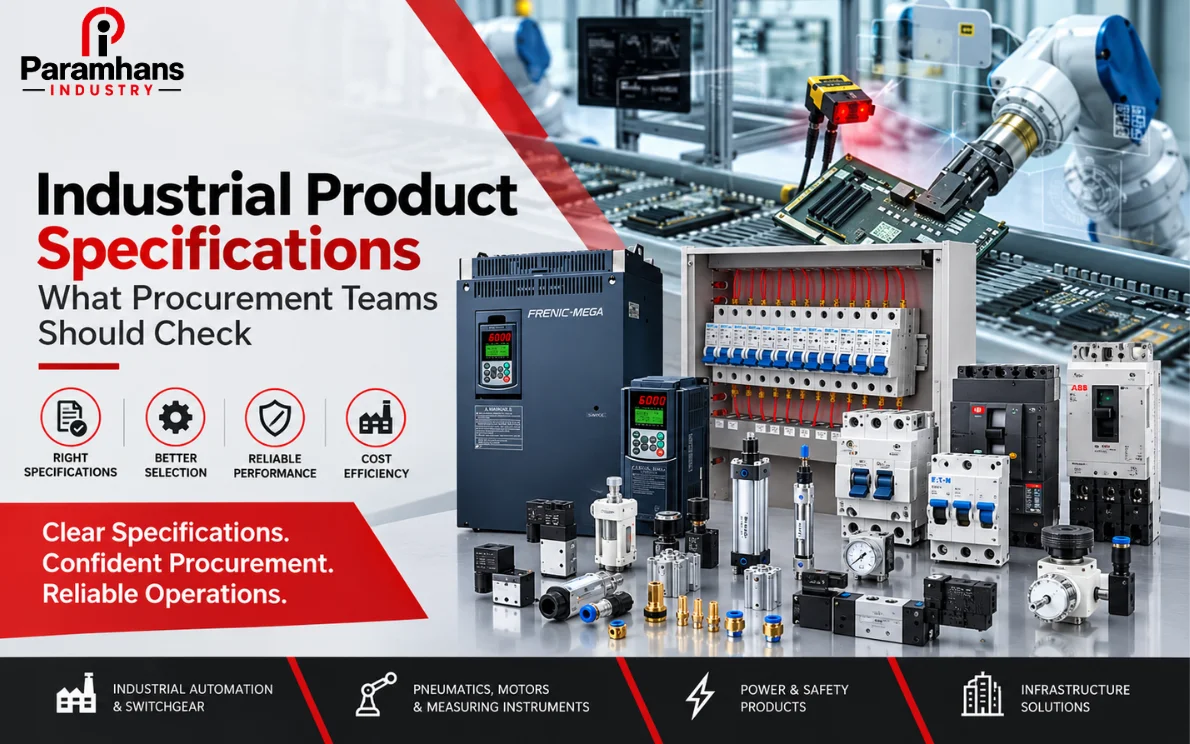
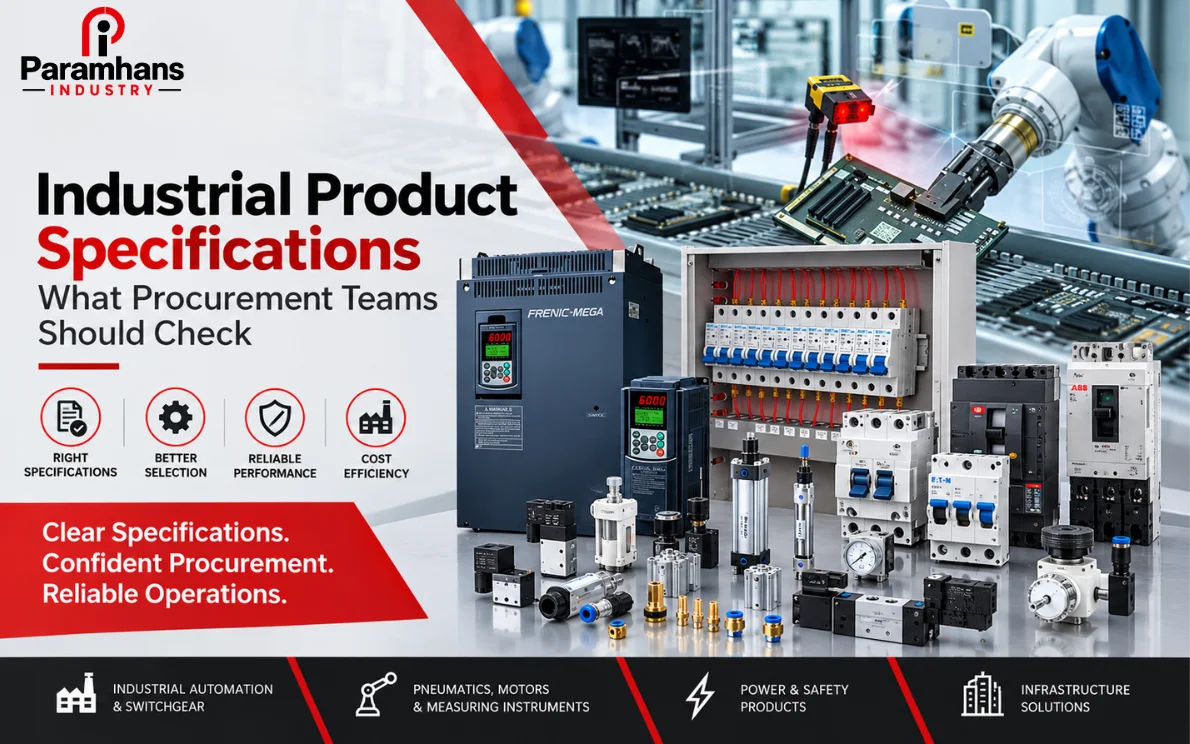
Industrial product specifications should convert an operating need into measurable requirements that suppliers can quote, engineers can review and inspectors can verify. Before issuing a purchase order, procurement should check product identity, duty, ratings, interfaces, materials, environment, safety, applicable standards, documentation, accessories, warranty and acceptance criteria. A catalogue description is useful, but it is not a complete specification.
The aim is not to create the longest possible data sheet. It is to define the few parameters that determine whether the product will work safely and reliably in the intended system. Every requirement should have a reason, a clear unit or condition and an evidence source. Ambiguous words such as heavy-duty, premium or industrial-grade should be replaced by values, test requirements or approved references.
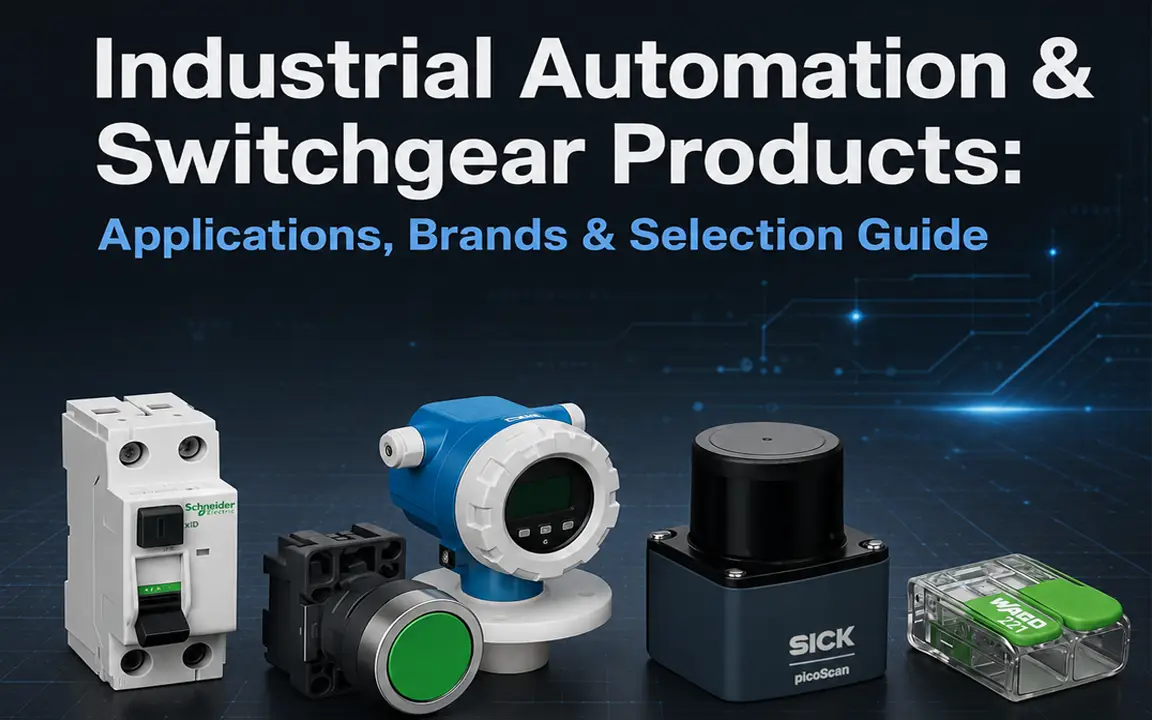
Paramhans Industry supplies multiple industrial categories, including industrial automation and switchgear, pneumatics, motors and measuring instruments, and power and safety products. A cross-category procurement process therefore needs a consistent specification checklist while preserving product-specific engineering review.
Specification, Datasheet, BOQ and Compliance Statement
| Document | Primary purpose | Key limitation |
|---|---|---|
| User requirement | Explains process need, duty and expected outcome | May not define a purchasable product |
| Technical specification | States mandatory measurable requirements | Must remain current and unambiguous |
| Datasheet | Describes a manufacturer model or range | May include options not in the quotation |
| BOQ or item description | Defines quantity and commercial line item | Can be too short for technical acceptance |
| Compliance statement | Maps the offer to each requirement | Only useful when evidence and deviations are stated |
| Approved submittal | Freezes the selected model, data and documents | Needs revision control and change discipline |
These documents should align. The requirement defines the duty; the specification translates it into criteria; the supplier identifies the exact model and options; and the compliance statement demonstrates the match. The approved submittal becomes the basis for manufacturing, dispatch, receiving inspection and maintenance records.
If the quotation references a product family but not the exact ordering code, the buyer may receive the wrong voltage, range, enclosure, connector or accessory. Procurement should not issue the order until the model configuration is traceable to the technical offer.
Start with the Application and Operating Duty
Write where the product will be installed, what process it supports, how often it operates and what happens if it fails. A sensor on a packaging line, a breaker feeding a critical motor and a pneumatic valve in a dusty plant have different consequences and evidence needs. Include normal duty, start-up, shutdown, upset and maintenance conditions.
Record the controlled medium, load, speed, pressure, temperature, current, voltage or measurement range relevant to the product. Identify continuous, intermittent, standby or cyclic service. If the process changes across batches, specify the complete operating envelope rather than one preferred point.
Core Specification Categories
Product identity and configuration
Specify manufacturer, product family, model or approved equivalent, complete ordering code and revision where appropriate. List every selectable option that affects fit or function. If alternatives are allowed, define the minimum performance and documentation they must satisfy instead of accepting “equivalent” without a comparison.
Electrical ratings
Depending on the product, check supply voltage and tolerance, frequency, phases, current, power, control voltage, short-circuit or interrupting rating, insulation level, contacts, signal type, output load and power consumption. Confirm AC or DC and the applicable utilisation category. Do not infer electrical compatibility from connector shape.
Mechanical and dimensional requirements
Check overall dimensions, mounting, shaft or port size, threads, flange, orientation, weight, clearances and allowable loads. Drawings matter when equipment must fit a panel, machine or replacement position. Tolerance and mating details can be more important than nominal dimensions.
Process and performance ratings
For instruments, define range, accuracy, repeatability, response, output and calibration. For drives and motors, define duty, torque, speed, overload and control needs. For pneumatic products, define pressure, flow, porting, media quality and switching. Performance should be stated under identified conditions.
Environment and enclosure
State indoor or outdoor use, ambient range, humidity, altitude, dust, water, vibration, shock, corrosive atmosphere, washdown, hazardous area and electromagnetic environment. If an IP rating, material grade or coating is required, link it to the actual exposure and request evidence for the offered model.
Safety and applicable standards
Identify the law, code, project standard or client requirement that applies. Avoid copying a list of standards from another project. The responsible engineer should determine relevance, edition and required certification or test evidence. A mark on a brochure does not automatically prove compliance for every variant.
A Universal Procurement Specification Checklist
| Category | Questions to answer | Evidence |
|---|---|---|
| Duty | What will the item do and under which range? | Process data and design basis |
| Ratings | What electrical, mechanical or process limits apply? | Exact-model datasheet |
| Interfaces | How does it mount, connect and communicate? | Dimension and wiring drawings |
| Environment | What temperature, dust, water, vibration or chemicals occur? | Environmental ratings and test data |
| Safety | Which protection, approvals and standards are required? | Certificates or reports where applicable |
| Scope | Which accessories, software, licences and services are included? | Itemised quotation |
| Quality | How will identity and conformance be checked? | Inspection and documentation plan |
| Life cycle | What warranty, spares and support are needed? | Written commercial terms |
Check Interfaces Before Comparing Brands
Most replacement problems occur at interfaces. Check physical mounting, electrical terminals, communication protocol, network parameters, firmware compatibility, pneumatic ports, cable glands, connectors, sensor targets, actuator stroke and control logic. A product can exceed performance requirements and still be unusable because it cannot connect to the installed system.
For brownfield procurement, photograph the existing nameplate and connections, but do not order from photographs alone. Retrieve the current drawing, bill of materials and change history. The failed item may already be an incorrect substitution, and a readable front label may omit suffixes that define critical options.
Product-Specific Examples
VFDs and motor control
A VFD specification may include supply, motor rating, full-load current, overload duty, output frequency, control mode, braking, I/O, communication, enclosure, ambient derating, harmonic strategy and required accessories. Motor power alone is not enough. The drive must match current, application duty and control architecture.
Industrial sensors
For a proximity or photoelectric sensor, define sensing principle, target material, range, repeatability, response time, output type, logic, connector, cable, housing, mounting, environment and indication. Confirm whether the control system expects PNP or NPN, normally open or normally closed, analogue or digital output.
Circuit breakers and switchgear
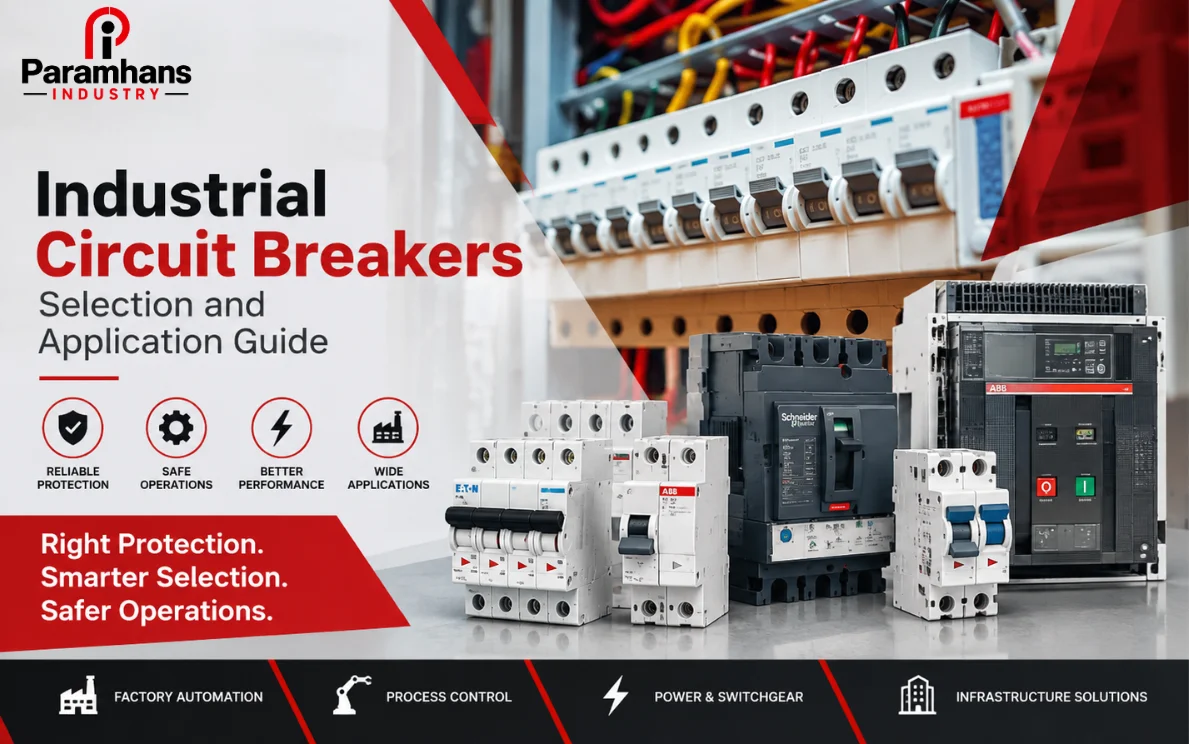
Check poles, rated voltage, current, frequency, breaking capacity, trip curve or protection settings, utilisation, coordination, accessories, terminals, mounting and standards. The same frame size can accept multiple releases and accessory combinations. Review system fault level and selectivity through competent electrical engineering.
Pneumatic components
Specify working pressure, proof limits, flow, media, filtration, lubrication policy, port thread, valve function, coil voltage, seal material, temperature, actuator bore and stroke as applicable. Air quality and cycle rate can change life. Include silencers, fittings, mounting kits and connectors when required.
Cables, tools and safety products
Cable procurement may require conductor material, size, cores, voltage grade, insulation, sheath, armour, flame or fire performance, drum length and test documents. Tools need capacity, speed, power supply and included accessories. PPE selection should follow hazard assessment and relevant approval—not only size or appearance.
Make the Compliance Matrix Useful
Create one row for every mandatory requirement. Require the supplier to state comply, deviation or not applicable and cite a page in the offered datasheet, drawing or certificate. Do not accept a matrix that simply repeats “yes” without identifying the offered value. Record deviations before technical approval, not after delivery.
Separate mandatory requirements from preferences. If every preference is labelled mandatory, competition may narrow without improving risk control. If critical items are merely preferred, evaluation becomes subjective. Assign responsibility for technical approval, commercial approval and exception acceptance.
Verify Authenticity and the Supply Chain
Match the quotation entity, manufacturer, brand, model, country information where relevant, warranty provider and invoice. Ask how serial numbers, batch numbers or manufacturer labels will be preserved. For sensitive components, confirm the approved sourcing channel and what documentation accompanies the shipment.
Paramhans describes itself as a supplier and distributor working across automation, switchgear, power, safety, welding and other categories. Review About Paramhans Industry and its brand portfolio, but verify availability, authorisation and warranty for the exact brand and item at the time of enquiry.
Include Accessories, Software and Services
A base product may not be an operational package. List mounting brackets, cables, connectors, power supplies, memory cards, licences, programming software, communication modules, batteries, filters, fittings, calibration certificates, commissioning and training. Clarify what the plant supplies.
Software is especially easy to overlook. Confirm licence type, number of users or devices, version, subscription, activation, updates, cybersecurity requirements, backup and ownership of project files. Avoid locking the system to an undocumented engineering laptop.
Evaluate Documents Before Dispatch
Define the document set at enquiry stage: datasheet, drawing, manual, wiring diagram, declaration, certificate, calibration record, test report, inspection record, packing list, warranty and recommended spares. State language, format and submission timing. Documentation arriving after installation may be too late for safe integration.
Use document numbers and revisions. If the supplier changes a model, firmware, material or drawing after approval, require a formal deviation and impact review. The purchasing team should not approve a commercial substitution without engineering acceptance.
Receiving Inspection and Acceptance
At receipt, compare purchase order, packing list, nameplate, ordering code, quantity, accessories, physical condition and documents. Quarantine discrepancies rather than sending them to stores or installation. Preserve packaging and photographs when transit damage is suspected.
Functional or calibration checks should be proportionate to risk. A high-consequence protection device may need more evidence than a standard hand tool. Define inspection level, sample size, witness points and acceptance criteria before shipment so both parties understand how conformance will be judged.
Compare Total Value, Not a Single Unit Price
Normalise offers for technical compliance and included scope before comparing price. Consider installation changes, accessories, engineering time, calibration, downtime, energy, consumables, licences, maintenance, spares and replacement lead time. An apparently cheaper item may create a costly adapter, panel modification or production risk.
Document lifecycle assumptions rather than claiming an exact total cost without data. The buyer should decide which costs are material for the duty and review them over a realistic period. Standardisation across installed equipment can reduce spares and training, but it should not override a critical performance need.
Divide the Review Between Procurement, Engineering and Users
Procurement should own RFQ completeness, bidder communication, commercial comparison, delivery terms and document traceability. Engineering should approve duty, ratings, interfaces, safety, standards and deviations. Operations and maintenance should confirm accessibility, spares, skills, shutdown constraints and preferred service practices. Quality may define inspection, certificates and non-conformance handling.
The boundaries should be written in a responsibility matrix. A buyer should not be expected to approve a protection setting, while an engineer should not silently accept an excluded accessory that changes the commercial scope. One named coordinator can close clarifications and maintain the controlled offer.
Hold a short technical-commercial alignment before award. Review every open deviation, included accessory, document, delivery assumption and service responsibility. Meeting minutes should reference the final offer revision. This step often prevents a technically acceptable product from becoming an incomplete purchase.
Control Approved Equivalents and Substitutions
When several brands are acceptable, define equivalence by function and interface: electrical ratings, mechanical fit, communication, environmental limits, safety evidence, lifecycle support and required accessories. Ask bidders to identify every difference. A higher headline rating cannot compensate for an incompatible protocol, footprint or warranty arrangement.
After award, substitutions should follow the same discipline. Require reason for change, comparison table, revised documents, schedule and cost impact. The technical authority should approve before dispatch. Update the bill of materials and asset record so maintenance does not unknowingly order the original item later.
Plan Spares and Obsolescence at Specification Stage
Ask about expected availability, recommended spares, repair policy, lead time, firmware support and successor models. Do not demand unsupported lifetime promises; request the supplier’s current lifecycle status and notice process. For critical components, identify whether a spare needs periodic charging, calibration, environmental storage or software preservation.
Standardising part numbers can reduce inventory, but spares should be based on failure consequence, installed quantity and replenishment time. Record the exact configuration and approved alternatives. A spare that physically fits but carries different firmware, trip unit or sensor output may not be usable during an emergency.
Common Specification Mistakes
- Copying an old specification without checking the current application, standard or installed interface.
- Specifying only brand and part family while omitting the complete ordering code and options.
- Using vague claims such as best quality, heavy-duty or latest technology as acceptance criteria.
- Treating catalogue maximum ratings as suitable continuous operating conditions.
- Forgetting derating for ambient temperature, altitude, enclosure or duty.
- Ignoring cables, connectors, licences, mounting kits and commissioning scope.
- Accepting undocumented equivalents or substitutions after technical evaluation.
- Comparing price before resolving deviations and scope exclusions.
A Step-by-Step Procurement Workflow
- Define the process need, operating envelope, consequence of failure and stakeholder responsibilities.
- Prepare measurable mandatory specifications and identify applicable standards.
- Issue the RFQ with datasheet, BOQ, drawings and a compliance-matrix template.
- Review offered model, options, deviations, interfaces, evidence and scope.
- Resolve technical clarifications and freeze the approved submittal.
- Compare commercial offers only after normalising compliant scope.
- Place the order with revision-controlled technical and documentation attachments.
- Inspect identity, condition, accessories and documents before acceptance.
- Update the asset record, drawings, spares list and maintenance information.
Frequently Asked Questions
1. What are industrial product specifications?
They are measurable requirements that define product duty, ratings, interfaces, environment, safety, evidence and acceptance for an industrial purchase.
2. Is a manufacturer datasheet the same as a specification?
No. A datasheet describes a product or range; a project specification defines what the buyer requires for a particular application.
3. What is the most important specification check?
Application fit is the starting point. Ratings, interfaces and environment must all match the actual duty.
4. Should procurement allow equivalent products?
Equivalents can be allowed when minimum performance, interfaces, documentation and evaluation criteria are clearly defined.
5. Why is the complete ordering code important?
Suffixes often define voltage, range, output, connector, enclosure, communication or accessories that the product-family name does not show.
6. What belongs in a compliance matrix?
Every mandatory requirement, the offered value, comply or deviation status, and a reference to supporting evidence.
7. How should catalogue maximum values be used?
Treat them as limits under stated conditions, not proof of suitability for continuous duty. Check derating and design margin.
8. Which accessories are commonly missed?
Cables, connectors, mounting kits, power supplies, communication modules, software licences, fittings and calibration documents are frequent gaps.
9. How can counterfeit risk be reduced?
Use verified supply routes, match legal and brand information, retain serial or batch traceability and confirm warranty for the exact item.
10. What should receiving inspection verify?
Ordering code, quantity, condition, accessories, nameplates, documentation and any defined functional or calibration checks.
11. When should a substitution be accepted?
Only after the responsible technical authority reviews documented differences and formally approves the change.
12. How many standards should be listed?
Only the standards relevant to the product and application. The responsible engineer should confirm edition and evidence requirements.
Turn Clear Specifications into Fewer Procurement Surprises
A strong industrial purchase begins with measurable duty, exact configuration and documented evidence—not a vague product label. Paramhans Industry supports procurement across automation, electrical, pneumatic, safety and related categories, including wiring, cabling and panels. Share your application, existing model, required ratings, quantity and delivery location through the Paramhans contact page to request an itemised offer that your engineering and procurement teams can evaluate against the same specification.
Social Share:





Our Blog







Captcha